


Skip the inspector and the repair list, and you can close in two weeks. Colorado allows that, yet plenty of sellers never learn it until they’ve already spent four thousand dollars on contractors, money they never needed to put into the place. Selling a house as is without inspection is legal here, though the rules about what you still owe the buyer catch people sideways.
Can You Sell a House as Is Without Inspection in Colorado?
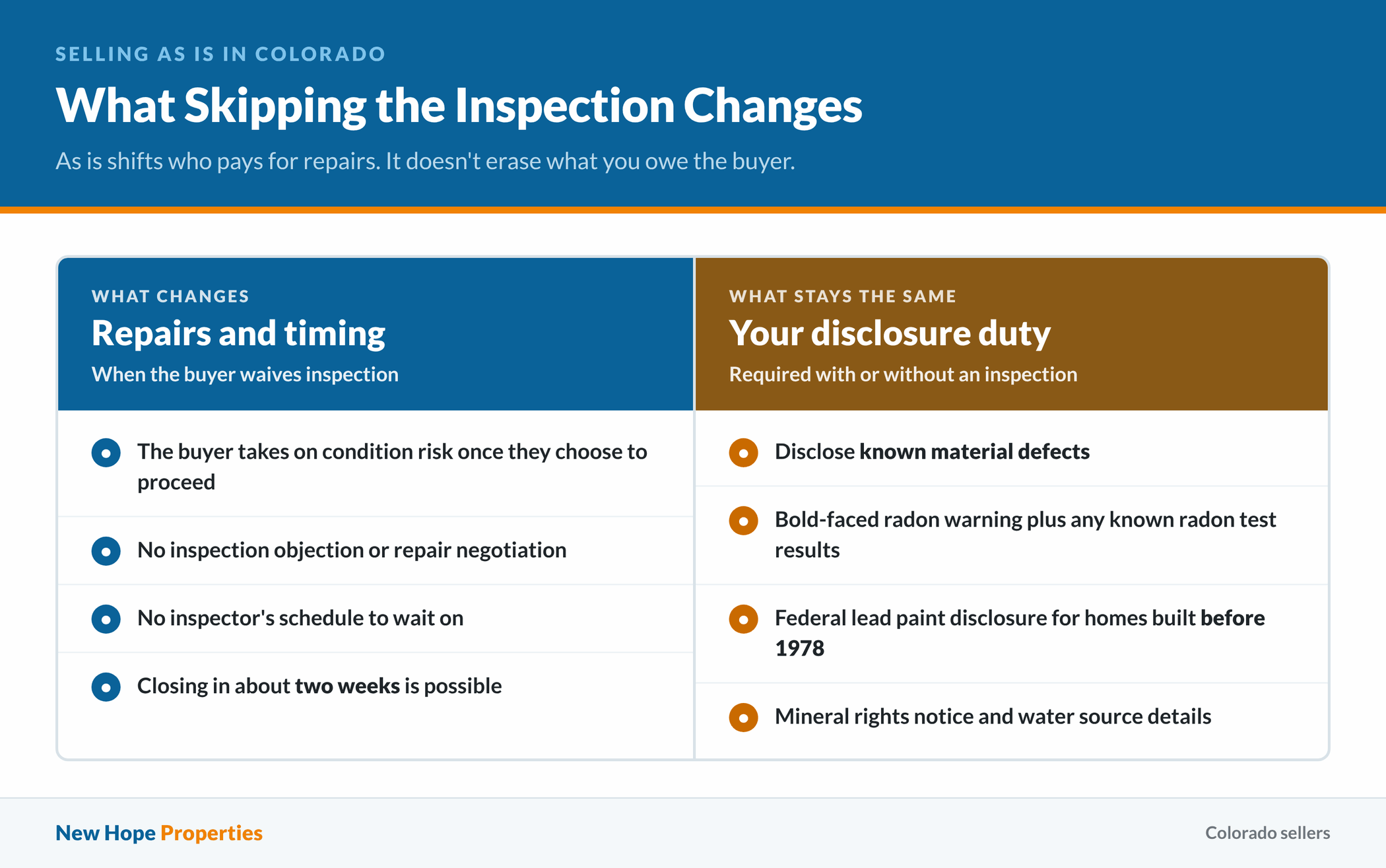
Colorado doesn’t require a home inspection for any residential sale. An inspection is a buyer’s right under the contract rather than a government checkpoint, so a buyer can waive it entirely. When both sides agree, the sale moves forward without inspection and nobody files a thing with the county.
Selling as is adjusts who pays for repairs; it never erases your duty to speak up about defects you’re aware of. I’ve watched sellers blur those two ideas for years, and that confusion is where lawsuits start.
One family I worked with had a wall of unopened medical supply boxes in the garage and a swamp cooler that hadn’t run since 2019. We closed that way on a Thursday. They’d filled out the disclosure form honestly about the cooler, the roof, and a basement seep they’d known about for years.
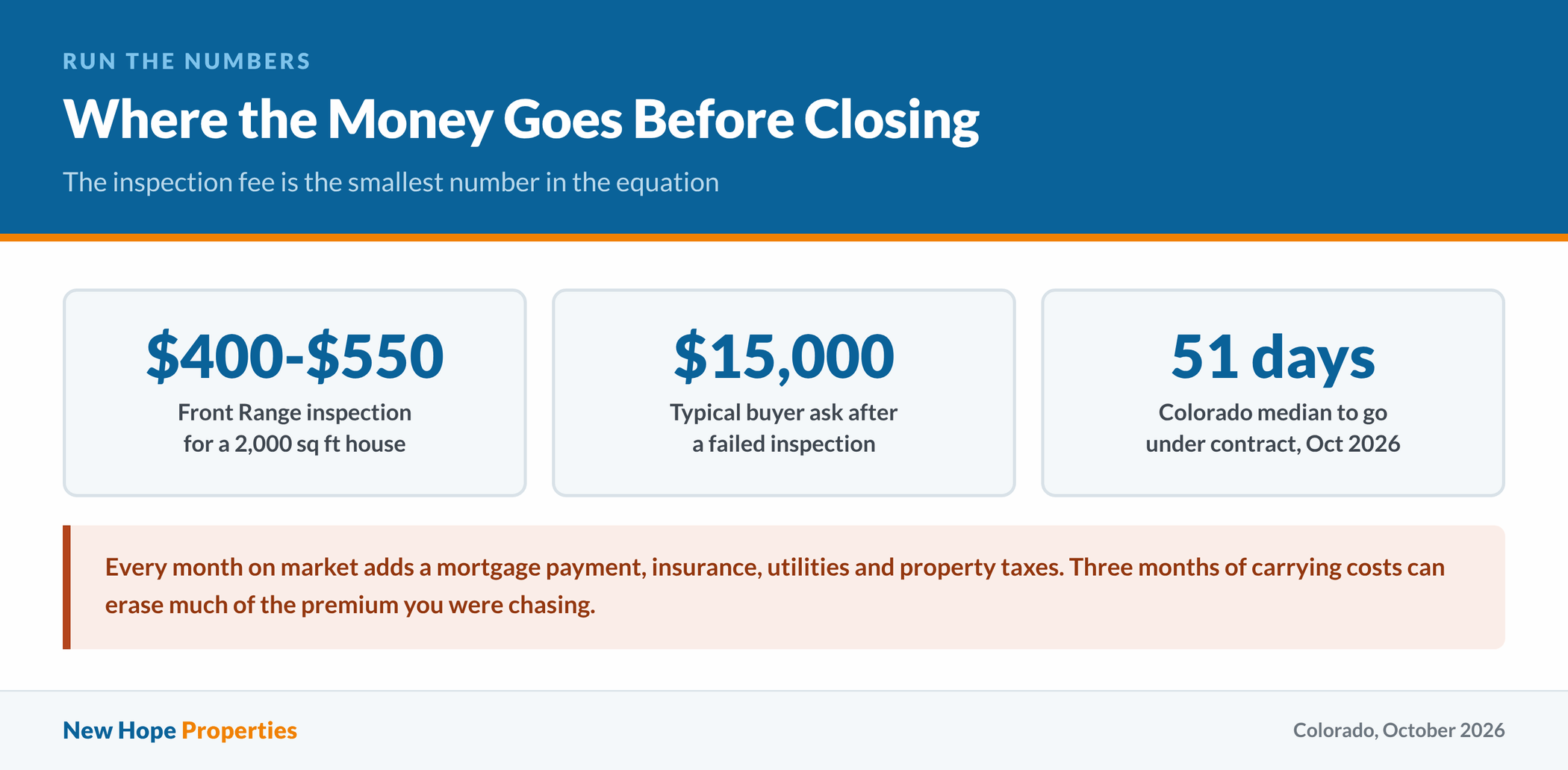
Market timing deserves some weight here. Colorado’s median sale price in October 2026 was $547,606, down slightly from a year earlier, and homes took a median of 51 days to go under contract. Add closing time, and a traditional listing in Colorado often runs well past two months from yard sign to money in your account. Selling this way squeezes that calendar hard, because the longest delay in most transactions is the back and forth over an inspection objection.
Is It Legal to Skip the Home Inspection in Colorado?
Sellers call me sure that a lender or a title company somewhere will demand an inspector walk the property. Then they find out the Colorado contract treats inspection as a deadline the two parties set for themselves. Nobody at the state level checks. If the buyer is paying cash, there’s no lender to object either, and the sale closes without inspection on whatever date you both pick.
A mortgage buyer still brings an appraiser, which is a different picture, since that appraiser works for the bank instead of your buyer. An appraiser won’t crawl your attic or scope your sewer line. A conventional loan generally tolerates a waived inspection, while FHA and VA loans carry their own minimum property standards that can trip up a rough house.
Here’s a surprise for most people: Colorado doesn’t license home inspectors at all. Vetting falls on whoever hires the inspector, and buyers usually look for certifications from ASHI or InterNACHI as a baseline. It’s purely a private service.
Does any of that make skipping it risk-free? No. A buyer who waives inspection and later feels burned will go straight to your disclosure form, since that form is where your legal exposure lives. The Division of Real Estate publishes the contract forms everyone uses, and you can read their broker advisory on current disclosure requirements before you sign anything in Colorado.
What Colorado Law Says About Selling Without an Inspection
A seller I worked with once had a contract fall apart over old wiring. Six weeks later she sold the same house without inspection to a buyer who already knew about the wiring, because she’d written it on her disclosure.
That sequence is the whole legal story in miniature. No single statute in Colorado orders a property-condition disclosure document, yet the duty to disclose is real and comes from several directions at once. You can’t point to one form and call yourself covered. Common law from the Colorado Supreme Court requires you to reveal latent defects you know about, and specific statutes pile on top for particular hazards.
Radon is the loudest of those. Under C.R.S. 38-35.7-112, every residential sales contract in Colorado must carry a bold-faced radon warning, and the seller has to hand over any known radon test results. The law demands a warning and disclosure, not testing. You can sell without inspection and without ever ordering a radon test, as long as you share whatever results you already have. Never tested? Say so. The EPA’s action level sits at four picocuries per liter, and Colorado’s geology pushes a lot of homes above it. You can read the enacted bill text at the Colorado General Assembly’s SB23-206 page.
Lead paint falls under federal rules for homes built before 1978, and that applies in Colorado whether you sell without inspection or with one. Properties with multiple structures, well water, or a septic tank bring extra questions on the standard form.
What Disclosures Are Still Required If You Skip Inspection?
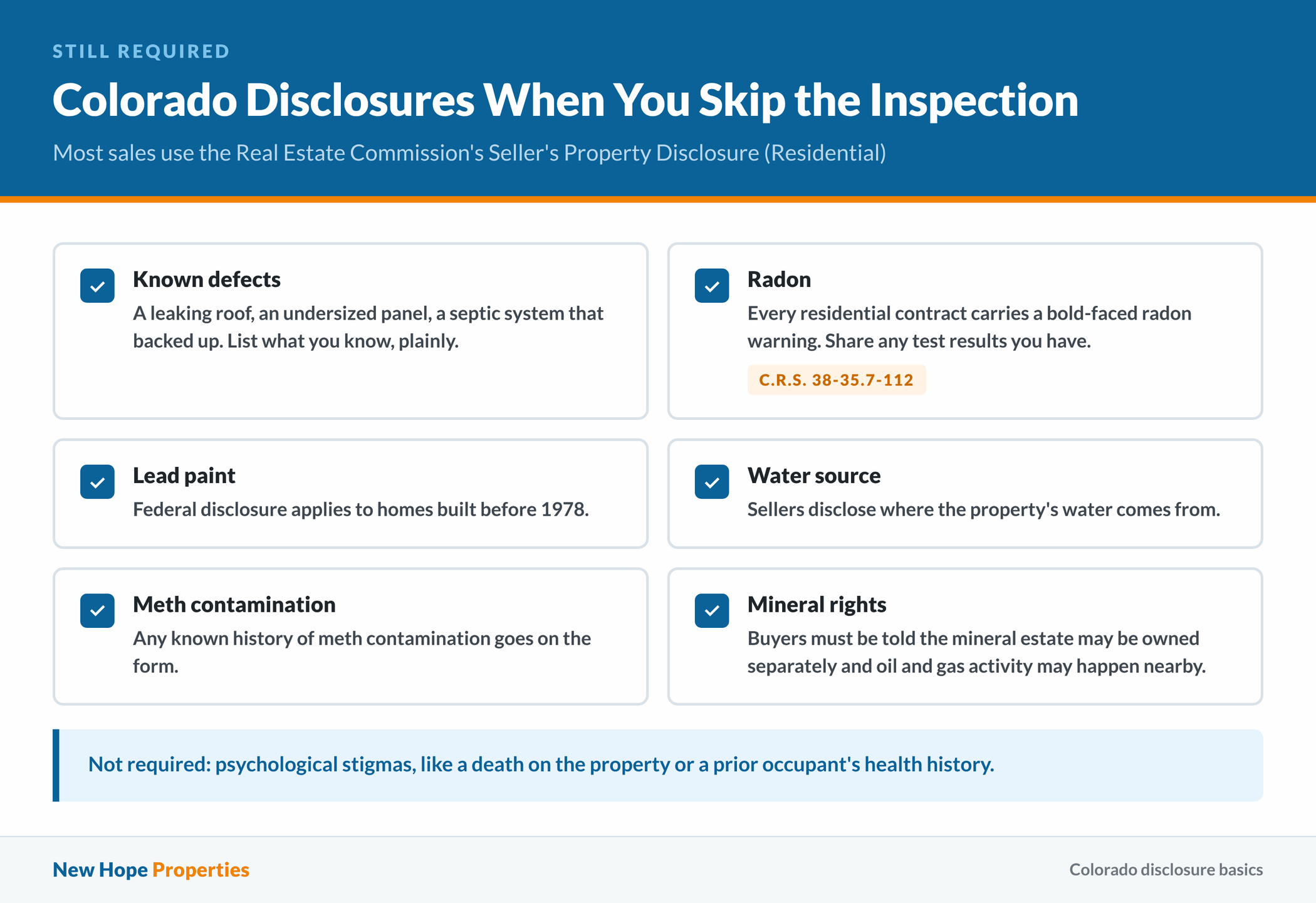
You’ll still want a disclosure form. Colorado statute doesn’t require a specific one, but nearly every transaction in the state uses the Real Estate Commission’s Seller’s Property Disclosure (Residential). Title companies expect it, and most buyers ask for it. Leaving it out of a sale without inspection looks like you’re hiding something, even when you aren’t.
List what you know, plainly. A roof that leaks during spring melt. The electrician who said the panel was undersized. A septic system that backed up two winters ago.
Sellers in Colorado also disclose the water source, any meth contamination history, and common interest community details for condos and HOA properties. Mineral rights get their own Colorado requirement. Buyers must be told the surface estate may be owned separately from the mineral estate, and that oil and gas activity may happen on or near the property. Sellers near Western Slope gas fields run into that one constantly.
Colorado law doesn’t require you to disclose psychological stigmas like a death on the property or a prior occupant’s health history.
Plenty of sellers won’t like my advice here: disclose more than the minimum when selling without inspection. A buyer who waives inspection is leaning on your word. A thorough form plus a stack of old roofer invoices builds a record. New Hope Properties always asks sellers to complete the disclosure even when we buy as is, because a clean paper trail protects everybody at the table.
Do Buyers Ever Waive Inspection on Colorado As-is Homes?
You might figure no sane buyer signs away their inspection on a house with a bad roof. Investors do it daily across Colorado, because they’ve already priced the roof into their offer.
A retail buyer picking out a family home can’t afford a surprise sewer line, so they need the inspection contingency as an escape hatch. An experienced buyer going without inspection assumes problems exist and underwrites for them. We’ve bought houses where the seller told us the furnace was dead, and we never sent anyone out.
Retail buyers waive too, though it’s rarer now than during the 2021 frenzy. Mesa County ended October 2026 with 1,049 active residential listings, up 36.6 percent from a year earlier, according to the Bray Report. With that kind of leverage in Colorado, few of them give up an inspection on a listed home.
A Colorado hail season can leave your roof in rough shape. If yours needs replacing, the buyer probably won’t be a young family using an FHA loan. It’s more likely to be an investor or a contractor who buys homes. They’re used to closing without an inspection, and they’ll have proof of funds ready when they make an offer.
Sellers get stuck when they try to have it both ways. They list the house as is on the MLS and hope a retail buyer will skip the inspection. Then months go by, and every buyer who shows interest still asks for one. Pick a lane early. Either you sell to buyers who expect an inspection, or you sell to buyers who don’t.
How Does Selling Without Inspection Affect Your Sale Price?
A landlord in Montrose inherited a duplex with 30 years of deferred maintenance and no cash to fix it. He wanted retail pricing. The offers he got came in 18 percent under comparable renovated units, and he took one anyway.
In Colorado, selling without inspection almost always means you’ll get less than a fully updated comparable would bring. What you get back is certainty and a faster sale. You also skip paying for repairs.
Run the numbers before you decide. Colorado single-family sales dropped 19 percent in October 2026, according to the Colorado Association of REALTORS. The statewide median single-family price also eased 0.7 percent to $575,000. With homes selling more slowly, a listed fixer sits longer. Each month on the market costs you a mortgage payment, insurance, utilities and property taxes. On a Colorado home, three months of those carrying costs can wipe out much of the premium you were chasing.
A Colorado home inspection runs roughly $400 to $550 for a 2,000 square foot house along the Front Range, and that’s the smallest number in this equation. The repair list that follows is what drains accounts. One failed inspection on a listed property routinely produces a $15,000 ask from the buyer.
So does selling without inspection cost you money? Usually, on paper. Whether it costs you in reality depends on your repair budget, your timeline, and how much of your life you’d spend managing contractors who don’t return calls.
What Are the Risks of Selling a House Without an Inspection?
Parts of Colorado get some of the most punishing hail in the country. A roof that looks fine from the driveway can be a total loss to an insurance adjuster. A seller may honestly not know that, and not knowing is your best protection. Knowing and staying quiet is your biggest risk.
Sellers who skip inspection sometimes assume the worst and accept an offer discounted for problems that don’t exist. Someone convinced of foundation trouble might be looking at ordinary settling cracks. One structural evaluation before you sell without inspection can be the cheapest money you ever spend.
Buyer flakiness is the other risk. Some buyers sign without inspection, schedule a “walkthrough” that’s really an inspection, then ask for a price cut. Ask for proof of funds and how many Colorado closings they’ve completed.
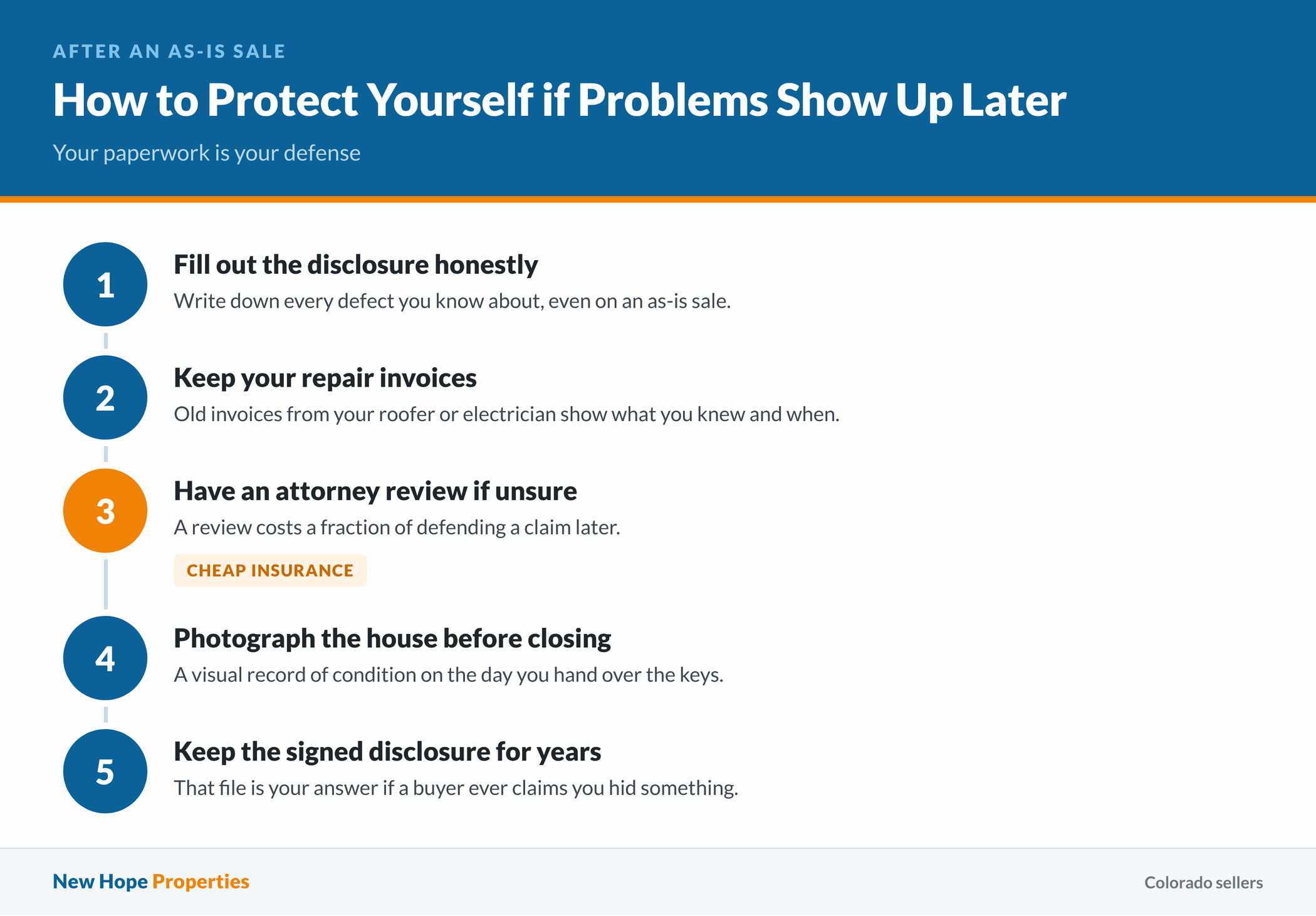
Then there’s disclosure exposure, which outlasts the closing. A seller who hides a known material defect can face a buyer’s claim even when the sale happened without inspection and the contract said as is. Selling for cash doesn’t suspend Colorado’s statutory disclosure article or the common-law duty. If you’re unsure whether something qualifies, a real estate attorney can review your disclosure for a fraction of what defending a claim costs.
An insurance carrier may also balk at an aging roof or knob-and-tube wiring, and that can sink the sale days before closing in Colorado.
What Happens If You Sell Without Inspection and Problems Show Up Later?
I tell every seller the same thing: the question isn’t whether problems show up. It’s whether you wrote them down.
A buyer who finds a cracked heat exchanger after closing generally has no claim if you didn’t know about it and your paperwork shows that. The as-is language in a Colorado contract shifts condition risk to buyers who had their chance to investigate and chose to proceed without inspection.
Your furnace repair invoice in the filing cabinet, though, is evidence you knew. Colorado courts have held sellers liable for failing to disclose known material facts. The Colorado Bar Association’s journal covers those cases in its discussion of adverse material facts and latent defects.
Photograph the house before closing, and keep a copy of the signed disclosure for years. That file is your defense if a buyer ever claims you hid something after a sale without inspection.
An investor who bought your property without inspection and renovated it will struggle to argue they were deceived about condition, since judging condition is their whole business. A first-time buyer who waived inspection to beat other offers is a different story in front of a judge.
A seller in Fruita called me three months behind on her mortgage, with an auction date set and a basement full of her late husband’s woodworking tools. We bought the house without inspection and closed before the sale date, and she kept the equity she’d have lost at the courthouse steps. That only worked because nobody waited on an inspector’s schedule. If you’re facing something similar in Colorado, New Hope Properties can quickly tell you whether a direct sale fits.
Frequently Asked Questions
Will a Buyer Waive the Inspection on My Colorado House?
Many will. Colorado treats the inspection as a contract right the buyer holds, so a buyer is free to waive it and close on condition as-found. Cash buyers do this constantly, though a lender may impose its own property standards when financing is involved. If your buyer is closing without inspection, they’re relying on your disclosure, so fill it out carefully and completely.
Does Selling as Is Mean I Don’t Have to Tell the Buyer Anything?
No, and that’s the single biggest misunderstanding I run into. As is covers who pays for repairs, not what you have to reveal. Your duty to disclose known material defects in Colorado survives an as-is clause completely, including the radon information the state requires in every residential contract.
Should I Get My Own Inspection Before Selling Without Inspection?
It depends on what you’re trying to learn. A pre-listing inspection gives you leverage and keeps you from underpricing out of fear, but in Colorado anything it uncovers becomes something you know and must disclose. If your house is in decent shape and you’re on the fence about selling, one evaluation can be worth it. When you already know the house needs work and you want out quickly, it’s money you don’t need to spend.
If you’re weighing a sale without inspection and want someone to look at your actual numbers, we’re glad to talk it through. There’s no pressure and no obligation, just a straight conversation about what your Colorado house is worth as it sits today and where your options go from here.
Get an Honest As-Is Offer
When you’re thinking about selling without an inspection, we can walk the property, look over your disclosure with you, and make a straight cash offer with no repair requests. Contact New Hope Properties or fill out the form below whenever you’re ready.