
A deed that transfers nothing at all is still a perfectly valid deed in Colorado. That sounds like a riddle, but it’s the single most useful fact about this document. A quit claim deed hands over whatever slice of ownership the signer happens to hold. If that slice turns out to be zero, the paperwork still records just fine at the county clerk and recorder’s office. I’ve bought houses across Colorado for years, and this one document causes more confusion among Colorado homeowners than almost anything else I run into.
What Is a Quit Claim Deed in Colorado?
Picture a brother adding his sister to the deed of their late mother’s house. Under Colorado law, the grantee isn’t required to sign anything. All the grantors listed have to sign in front of a notary, but the person receiving the property doesn’t sign the deed at all.
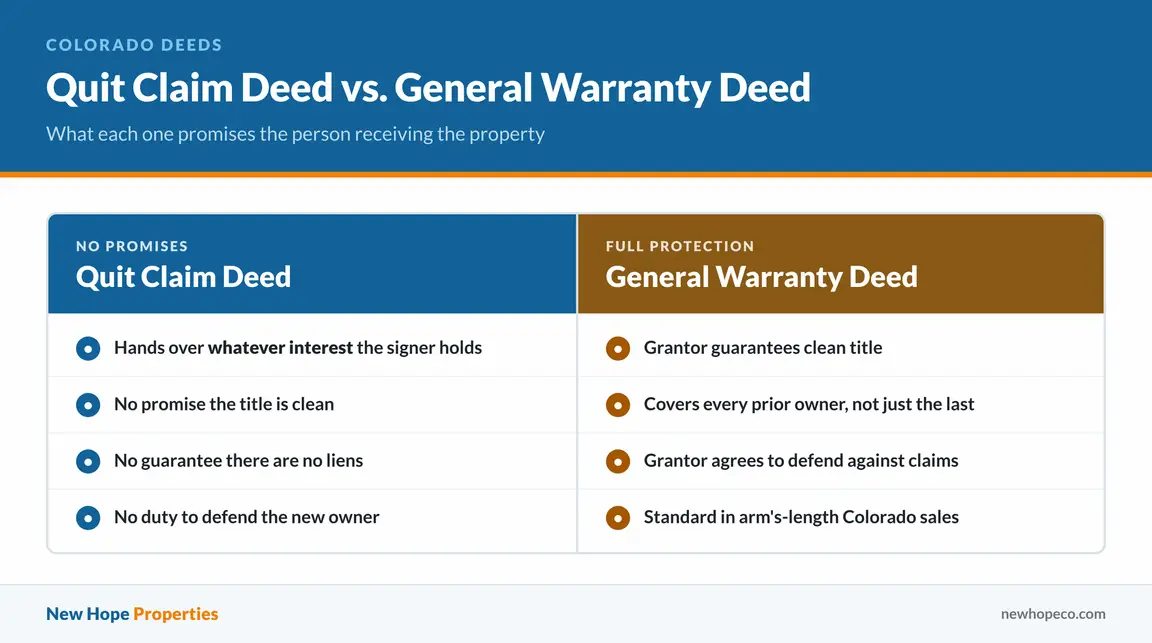
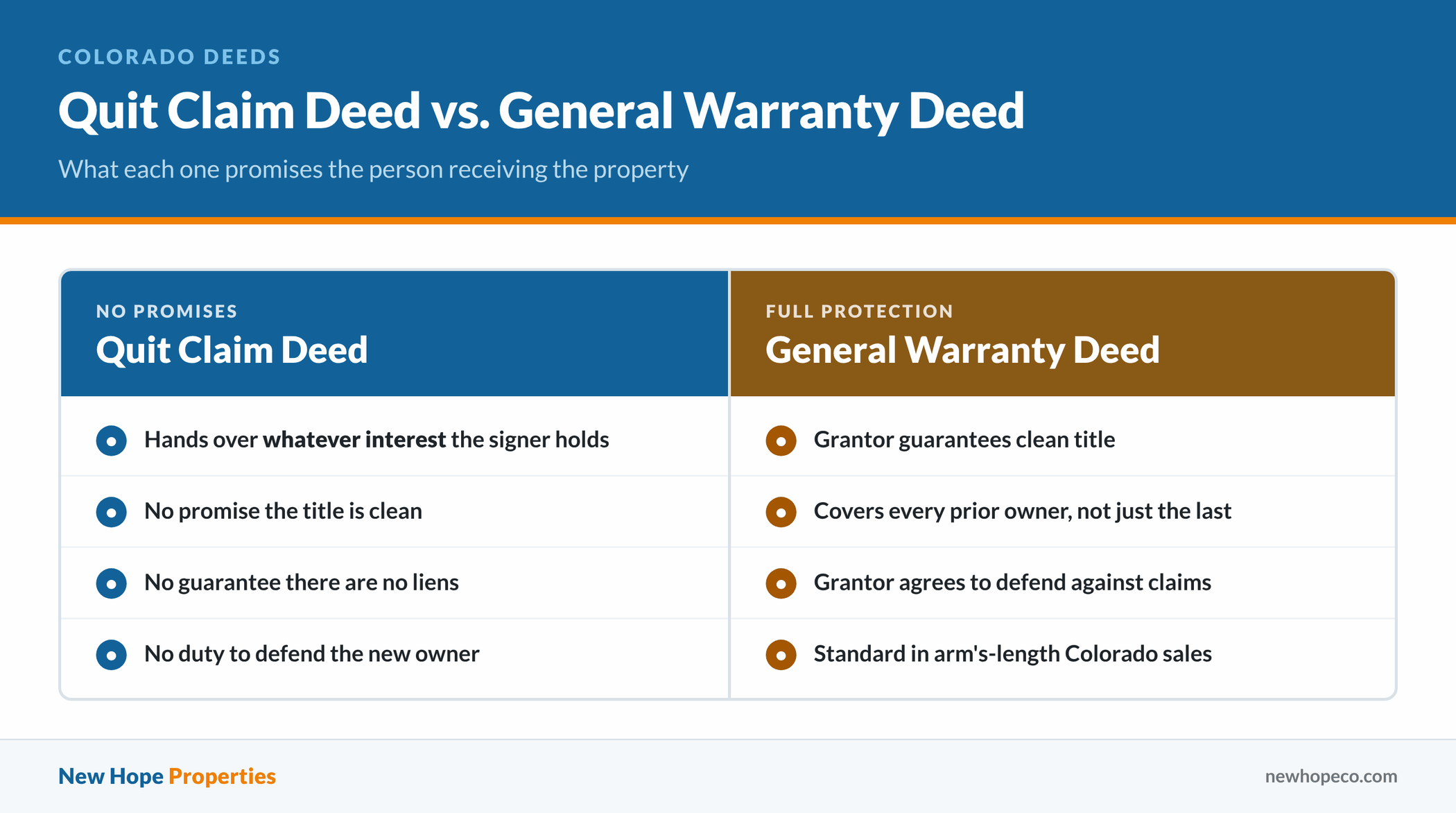
So what’s really happening in that document? A grantor says, in effect, “whatever interest I own in this parcel, it’s yours now.” No promises attached. No oath from the grantor that the title is clean, no guarantee there are no liens, and no agreement to defend you if a long-lost cousin shows up claiming a share.
That lack of warranties is the whole personality of a quit claim deed. A general warranty deed makes the seller stand behind the title going all the way back. This deed makes zero such promise. Title companies get nervous when one appears in a chain of ownership for exactly that reason. It transfers your interest with no warranty, full stop.
County clerk and recorder offices are used in Colorado instead of the separate register of deeds you’ll find in some other states. That office is where the deed gets recorded. There are 64 counties in the state, and each one runs its own clerk and recorder’s office.
One more wrinkle worth knowing: the price tag on these transfers is small compared to what Colorado real estate costs. Statewide, homes sold at a median of $547,606 in October 2026, down about half a percent from a year earlier, so a few dozen dollars in filing fees moves a half-million-dollar asset.
When Should You Use a Quit Claim Deed in Colorado?
These deeds belong in situations where everyone already trusts everyone, which is the only time I’d recommend them after seeing what happens otherwise. Adding a spouse to the title after a wedding. Removing an ex after a divorce decree. Moving a rental into your own limited liability company for liability reasons. Clearing up a misspelled name from a 1970s deed that’s been sitting in the records.
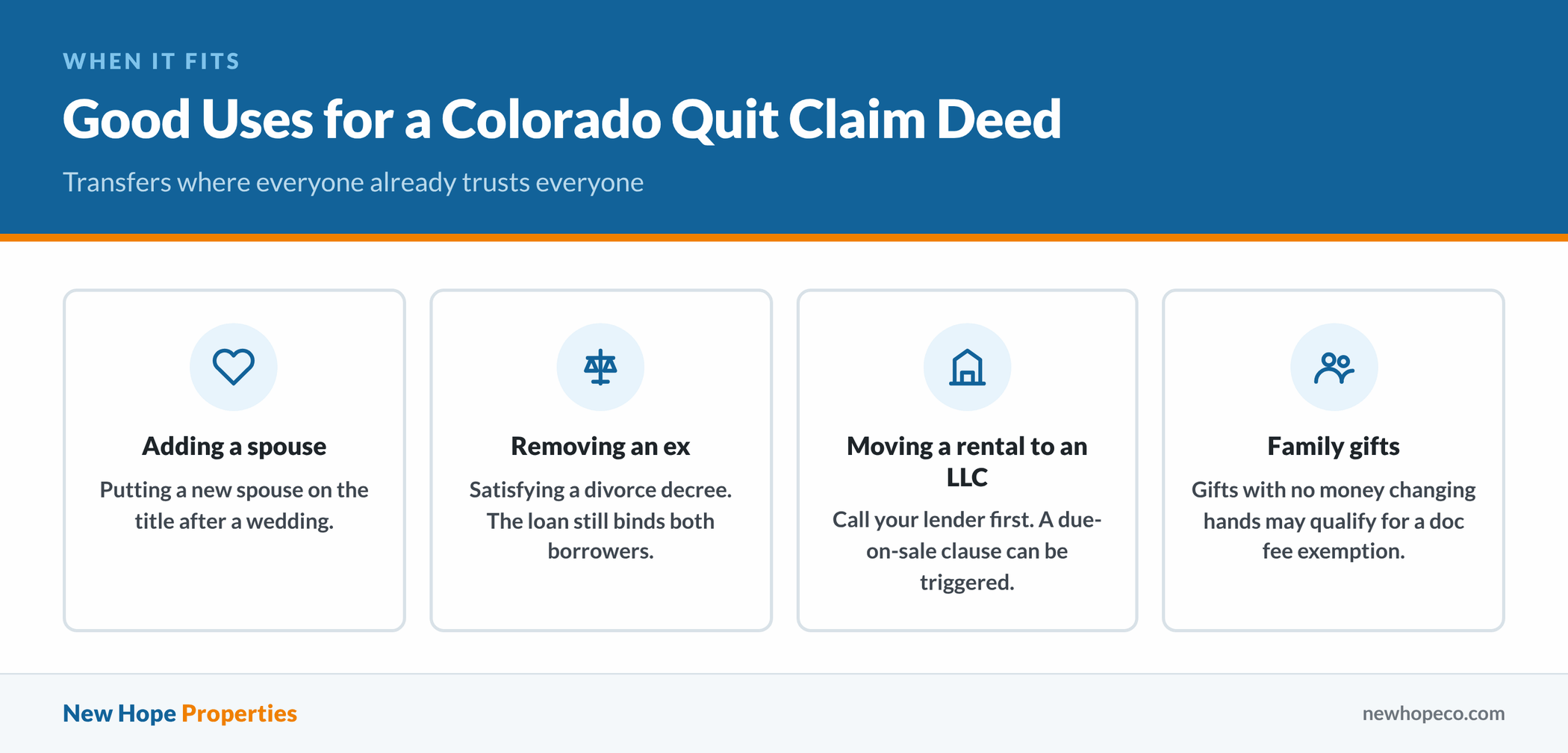
Divorce drives a huge share of the filings I see in Colorado. One spouse signs their interest over to the other, the decree gets satisfied, and everyone moves on, but that’s not actually the end of it. Both borrowers remain obligated: the signer’s name stays on the loan, and the lender still expects payments from both.
Transfers into limited liability companies form the second big category. Landlords in Colorado who own three or four doors often want each property held by a separate limited liability company. It gets the property from your personal name into the entity quickly. Call your lender before you do that, though. A due-on-sale clause appears in most deeds of trust, which a transfer can trigger.
Family gifts make up another common category. Parents putting an adult child on the title, siblings sorting out an inherited cabin near Buena Vista, a grandparent handing down land in the San Luis Valley. Gifts where no money changes hands may qualify for an exemption from Colorado’s documentary fee, though the recording still has to happen.
Where I’d push back on common advice: plenty of people online suggest using one to “avoid probate.” That’s a gamble with real consequences for Colorado families. A properly drafted beneficiary deed usually serves that goal better. A quit claim deed gives up control the moment it’s recorded.
Who Needs to File a Quit Claim Deed on a House?
Recording is what puts the world on notice. State law calls for recording the deed with the county clerk and recorder where the property is located, because without it the ownership change may not appear in public records at all. A race-notice priority system governs Colorado, so the party who records first generally wins against someone who records later.
Who’s on the hook for getting it filed? Practically speaking, the grantee cares most, since they’re the one receiving something. Whoever hands the deed to the clerk pays the fee, and Colorado law doesn’t require that person to be the grantee. Title companies handle the filing in most closings. In a family transfer, it often falls to whoever’s most organized.
Heirs settling an estate account for a big share of this document’s traffic in Colorado counties. Say three siblings inherit a house in Pueblo, two want out, one wants to keep it. Those two sign such a deed to the third. Clean, fast, cheap, assuming the estate itself has been handled correctly through probate first.
Divorcing couples, remarried couples combining households, business partners splitting a rental portfolio, people correcting a typo from a transfer made decades ago: all of them end up at a Colorado recorder’s counter eventually.
Here’s where I see families stumble. Someone signs a quit claim deed and never files it, then passes away, and now the paperwork is twenty years stale with a dead grantor. Untangling that costs real money and real time. If you’re sitting on an unrecorded deed right now, that’s your weekend project.
For anyone who ends up deciding the property is more trouble than it’s worth, selling is a legitimate exit. We buy houses throughout Colorado at New Hope Properties, including ones with messy title histories.
What Are the Steps to Complete a Quit Claim Deed in Colorado?
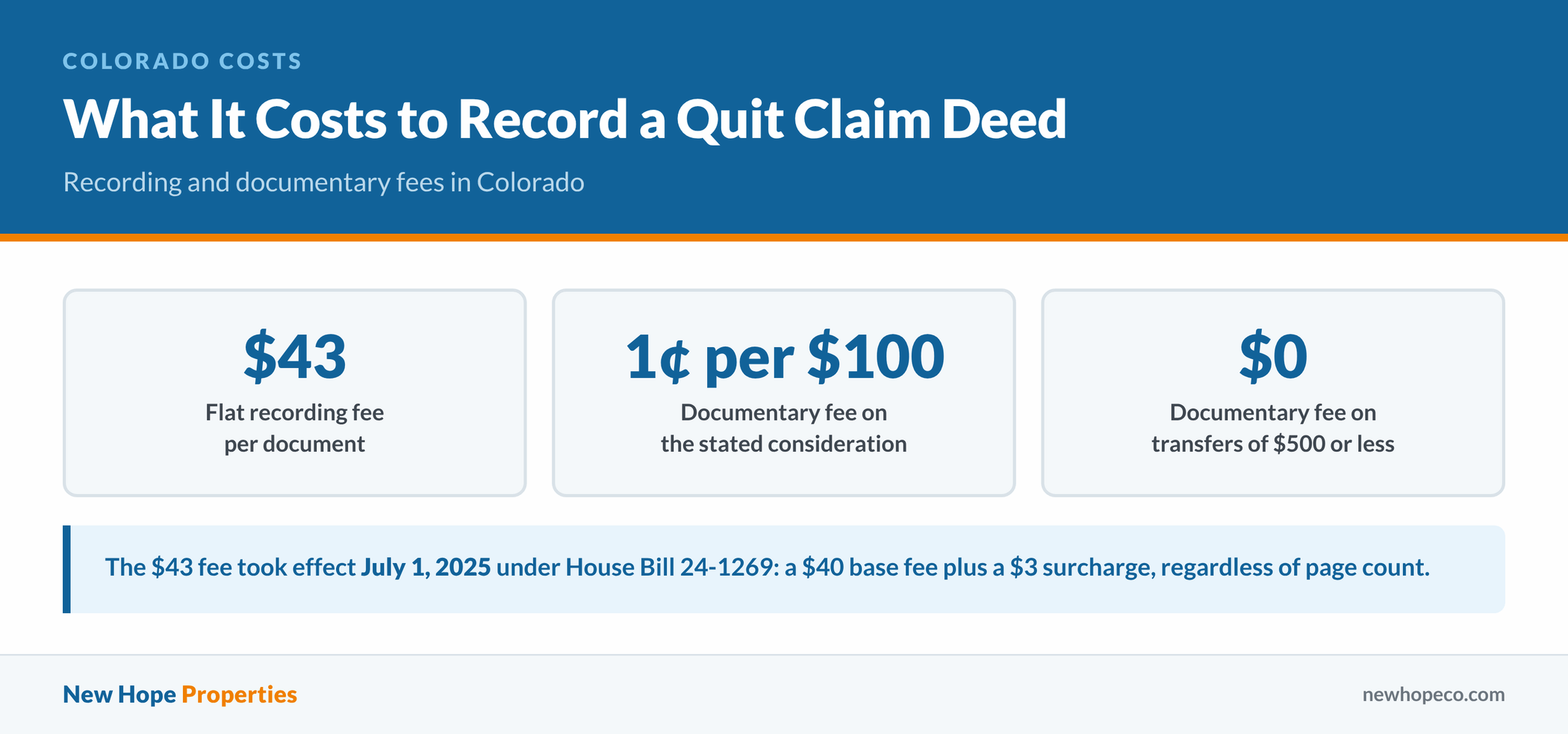
Across Colorado, the flat recording fee per document sits at forty-three dollars as of July 1, 2025, regardless of page count, a change that came from House Bill 24-1269. It breaks into a $40 base fee plus a $3 surcharge, which covers the Electronic Recording Technology Board and a clerk technology fee.
Start by pulling your current deed and copying the legal description exactly. Not the street address. The actual legal description with lot, block, and subdivision, or the metes and bounds for rural acreage. Street addresses get properties rejected.
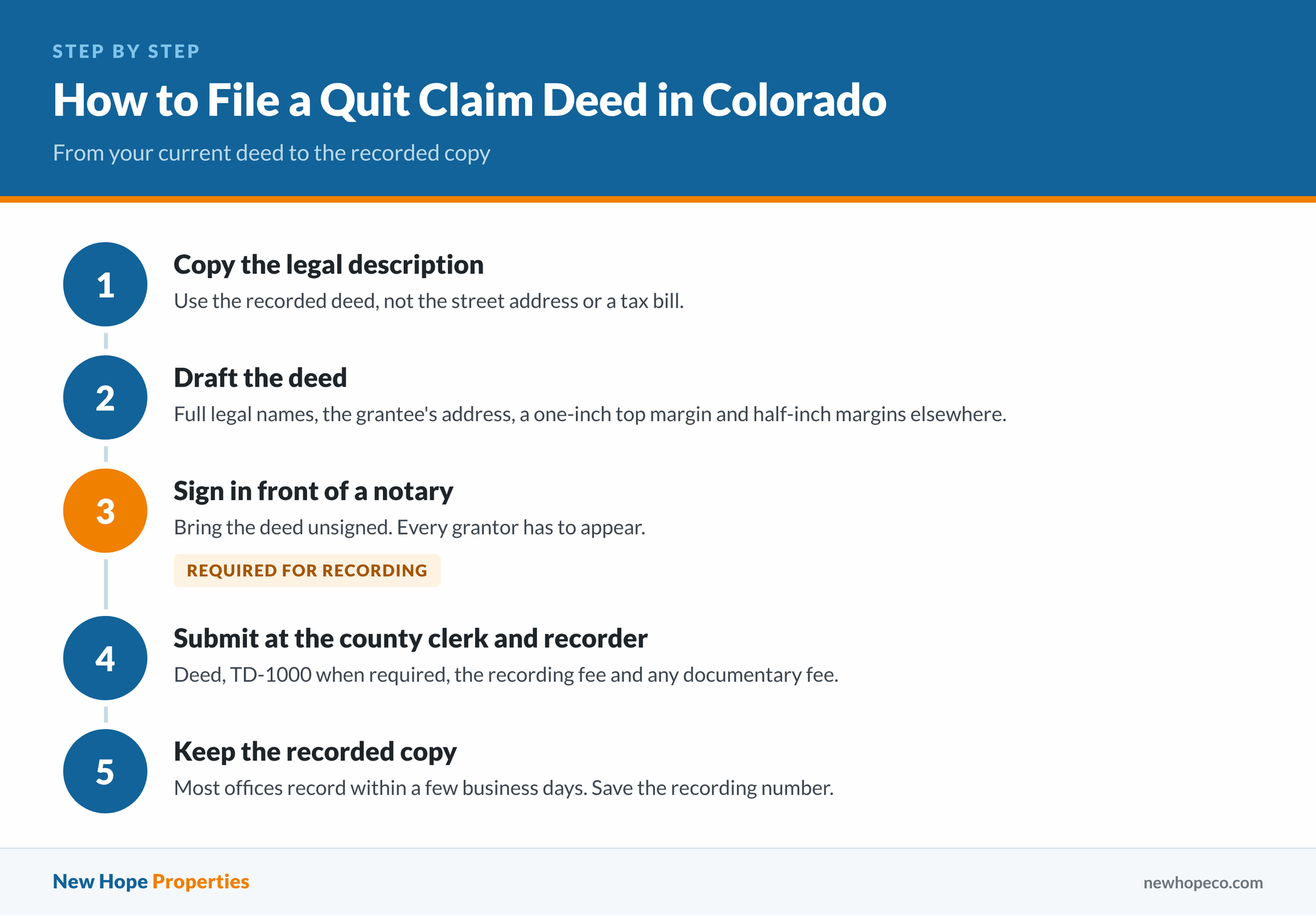
The deed itself has to hold up to scrutiny. It must be in writing, signed by the grantor, and name both grantor and grantee by full legal name. The grantee’s address has to appear, and Colorado law directs the clerk to return the deed unrecorded without it. Formatting counts too: a one-inch top margin and half-inch margins on the left, right, and bottom.
Before the deed can be recorded, Colorado requires the grantor’s signature to be acknowledged before a notary.
After notarization, you deliver everything to the right office. Submit the signed and notarized deed, the TD-1000 when it’s required, and the recording fee plus any documentary fee owed to the clerk and recorder in the county where the property sits. The Colorado Secretary of State publishes a roster of county clerks and recorders if you’re unsure which office covers your parcel. Property straddling a county line gets recorded in both.
The TD-1000 is the Real Property Transfer Declaration. Every conveyance document subject to the documentary fee has to arrive with one, signed by either the grantor or the grantee. It never gets recorded and stays confidential at the assessor’s office. You can download it from the Colorado Division of Property Taxation forms page.
Make a copy before you hand over the original. Most Colorado clerk offices record a deed within a few business days. Keep the returned deed along with its recording number.
Does a Colorado Quit Claim Deed Need to Be Notarized?
One Tuesday, a seller in Grand Junction called me after his deed came back from the county unrecorded.
Yes, notarize it. Statute in Colorado says even an unacknowledged recorded deed gives notice, but county clerk and recorder offices and title companies expect notarization, so get it notarized before recording. Arguing the fine points of that statute at the counter won’t get your document accepted.
Finding a notary in Colorado is easy and usually cheap. Banks and credit unions often notarize free for account holders, and UPS Stores, shipping outlets, and title companies all offer it too. Many Colorado counties also notarize at the clerk’s office, though fees and ID requirements differ by county, so phone ahead.
Bring the unsigned deed, because a notary can’t acknowledge a signature made before they saw it happen. If two people are granting the property, both need to appear, though they can do it separately and on different days.
Remote online notarization is available in Colorado. If your deed was notarized electronically, you’ll want to use a recording method your county accepts, because some rural Colorado counties handle electronic documents differently than Denver or Arapahoe does. Confirm before you pay for a remote session.
One pattern I keep seeing: people treat the notary step as a rubber stamp and rush it. The notary block has to be filled in completely, with the county, the date, the commission expiration, and the seal. A blank line in that block kills the filing just as effectively as a missing signature.
What happens if the grantor can’t physically get to a notary? That’s where a power of attorney comes in, and the POA itself typically needs to be recorded alongside the quit claim deed. Clerks in Colorado want to see the authority behind the signature.
What Mistakes Should You Avoid When Filing a Quit Claim Deed?
Skipping title research tops the list. A quit claim deed carries no warranties, so you inherit every lien, judgment, and easement riding on that property. Mechanic’s liens from a contractor nobody paid. Unpaid HOA assessments in a Highlands Ranch subdivision. Back property taxes.
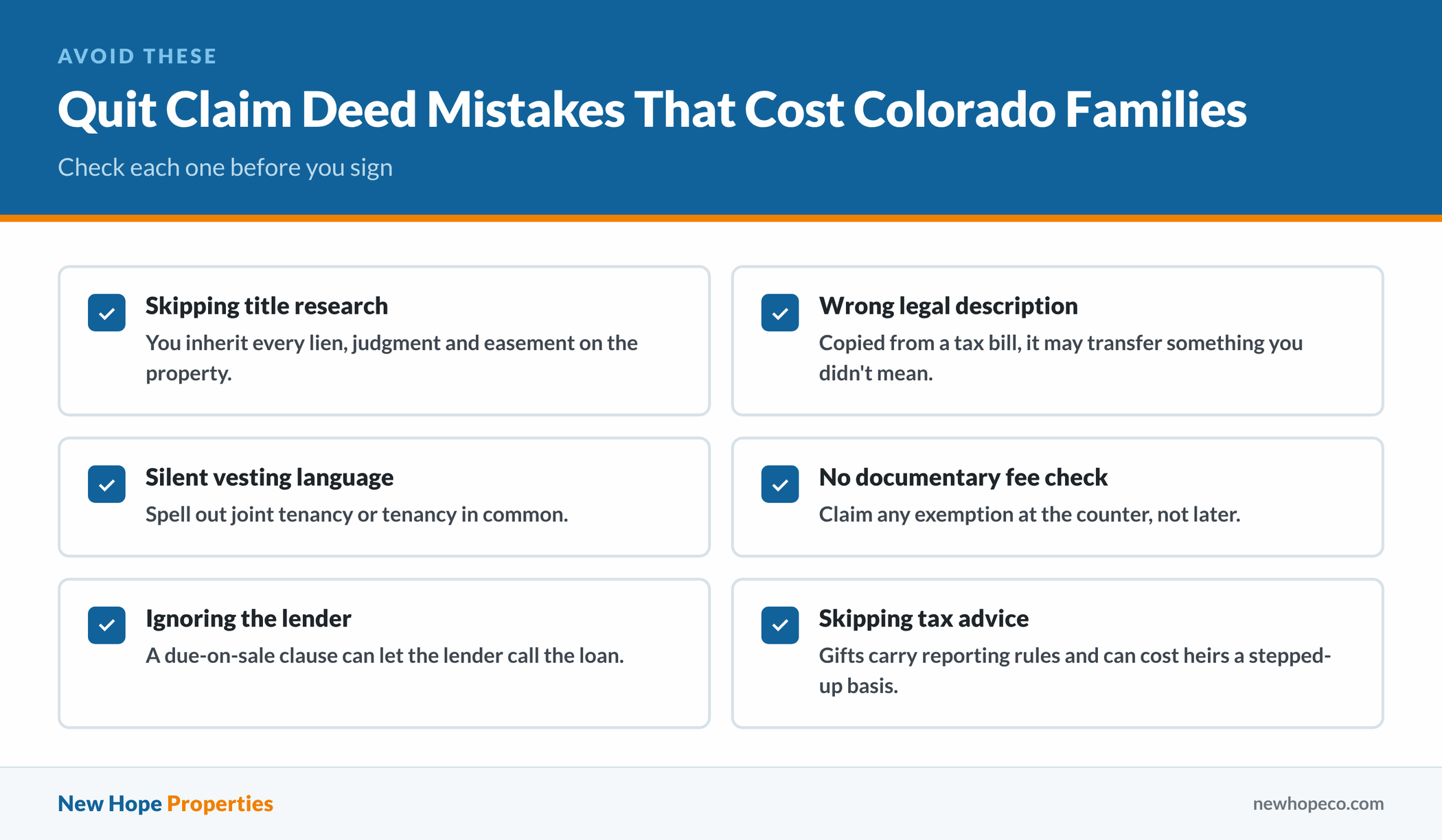
Using the wrong legal description runs a close second. Copying the description from a tax bill instead of the recorded deed produces a document that may transfer something other than what you meant.
Vesting language gets botched constantly. If two people are taking title in Colorado, the deed should spell out whether they’re taking as joint tenants with rights of survivorship or as tenants in common. Tenancy in common means each owner’s share passes through their estate. Leave it silent and Colorado’s default rules decide for you, which may not match what the family agreed to over dinner.
Forgetting the documentary fee analysis trips up gift transfers. Colorado charges a documentary fee of one cent per hundred dollars of consideration, applied to the full consideration stated in the deed. Transfers at $500 or less owe nothing. Claim your exemption at the counter rather than discovering the issue later.
Ignoring the lender is the error with the biggest teeth. Your deed of trust likely contains a due-on-sale clause, and moving title can give the lender the right to call the loan. Most lenders don’t act on routine family transfers, but “most” isn’t “all.”
Gifting real estate in Colorado has federal gift tax reporting consequences and can strip away the stepped-up basis your heirs would otherwise receive. A thirty-minute conversation with a CPA costs less than the tax bill from a transfer done backward.
What Other Colorado Property Deed Forms Might You Need?
In most situations a quit claim deed is the wrong tool, and Colorado gives you better options.
General warranty deeds are what show up in arm’s-length Colorado sales. The grantor guarantees clean title back through every prior owner and agrees to defend the grantee against claims. Buyers paying real money want that protection, especially at current Colorado prices. Denver metro’s median closed price rose about 3% in October 2026 to $592,000, with median days in the MLS dropping from 33 to 31, according to REcolorado’s monthly market report.
Special warranty deeds sit in the middle. The grantor only warrants against problems that arose during their own ownership, not anything before. Estates, trustees, and institutional sellers lean on these in Colorado because nobody wants to warrant a title they never examined.
Beneficiary deeds are Colorado’s quiet workhorse for estate planning. You record one now, keep full control while you’re alive, and the property passes to your named beneficiary at death without probate. Families who reach for a quit claim deed to dodge probate usually wanted this instead.
Personal representative’s deeds come out of probate, signed by whoever the court appointed to administer the estate. Public trustee’s deeds come out of foreclosure.
Prices vary enough across Colorado that the stakes shift by region. Colorado Springs saw a median sale price of $455,000 in October 2026, down 4% from $473,500 a year before, per the Colorado Springs market statistics.
A man called me on a weekday afternoon about a place he’d inherited over in Montrose. It was a 1960s split-level with a basement crammed full of thirty years of his late father’s belongings, including a disassembled motorcycle under a tarp. His siblings wanted a clean exit and no cleanout. We bought it as-is and the family signed one deed at closing.
Some owners weigh a quit claim deed against an outright sale. New Hope Properties can walk you through what the house would bring as-is in the current Colorado market, before anyone signs.
Frequently Asked Questions
What Are the Downsides of Using a Quit Claim Deed?
The big one is the total absence of warranties. You get whatever interest the grantor had, which might be partial, encumbered, or nonexistent, and you have no legal recourse against them if it turns out to be worthless. This type of deed also does nothing about an existing mortgage, so the original borrower stays liable. Most title insurers won’t issue a policy based on one without digging into the chain of title first.
What Does a Colorado Quit Claim Deed Form Actually Look Like?
It’s typically a single page naming the grantor and grantee by full legal name, stating the county where the property sits, reciting the consideration, and containing the complete legal description. Below that sits the grantor’s signature line and a notary acknowledgment block. Colorado doesn’t issue one official statewide form, so templates from attorneys, title companies, and legal document services all work as long as they meet the margin and content requirements your county clerk enforces.
Do You Have to Hire a Lawyer for This?
State law doesn’t require one. People handle simple transfers themselves all the time, especially adding a spouse or correcting a name. Still, I’d bring in a real estate lawyer anytime a mortgage is involved or a divorce decree needs satisfying. An estate with multiple heirs or a transfer into a limited liability company calls for one too. The attorney fee is small next to the cost of unwinding a bad transfer.
What Goes Wrong Most Often with These Filings?
Bad legal descriptions, missing grantee addresses, incomplete notary blocks, and wrong margins get documents bounced at the counter. The more expensive errors happen after recording: no title search beforehand, no vesting language between co-owners, no conversation with the lender, and no tax advice. Record the deed promptly once it’s signed, and keep the stamped copy somewhere you can find it.
Can You Undo a Quit Claim Deed After It’s Recorded?
Not unilaterally. Once the deed is recorded, the grantee owns that interest, and getting it back requires them to sign a new deed transferring it to you voluntarily. Courts will sometimes set a deed aside for fraud or incapacity, but that’s litigation, not paperwork. Be certain before you sign, because this is the step people most often wish they could take back.
If you’re staring at a property in Colorado and you’re not sure whether a quit claim deed, a sale, or something else makes the most sense, I’m happy to talk it through. No pressure, no obligation, and no hard sell if selling isn’t the right move for you.
Grand Junction Houses With Title Questions
Some owners finish the quit claim deed paperwork and decide they’d rather sell than keep the house. In Mesa County, active listings rose to 1,090 in September 2026, the highest count since 2014, according to The Bray Report. More competing listings can stretch a traditional sale, especially for a house with a messy title history.
New Hope Properties works as a cash home buyer in Grand Junction and can look at a house before or after a deed is recorded.
We also buy from owners in Montrose and across Colorado, including houses with liens or an open estate.
Talk It Through Before You Sign
You may not be sure yet whether to record a quit claim deed or sell the house. Either way, you can contact New Hope Properties with your questions. Fill out the form below, and someone from our team will call you back.
Helpful Colorado Blog Articles
- How to Sell a House By Owner in Colorado
- How to Sell a House During a Divorce in Colorado
- Can You Sell a House With a Mortgage in Colorado
- How to Sell Rental Property in Colorado
- How Much Does It Cost to Sell a House in Colorado
- Selling a House With Mold in Colorado
- Can a Jointly Owned Property Be Sold by One Owner in Colorado
- How Long Should You Live in a House Before Selling It
- Sell House With Water Damage in Colorado
- How Long Does It Take to Force the Sale of Property in Colorado?
- Can You Sell a House With a Lien in Colorado
- Can You Sell a House in Foreclosure in Colorado
- How to File a Quit Claim Deed on a House in Colorado
- How to Sell Your House Before Moving to Another State