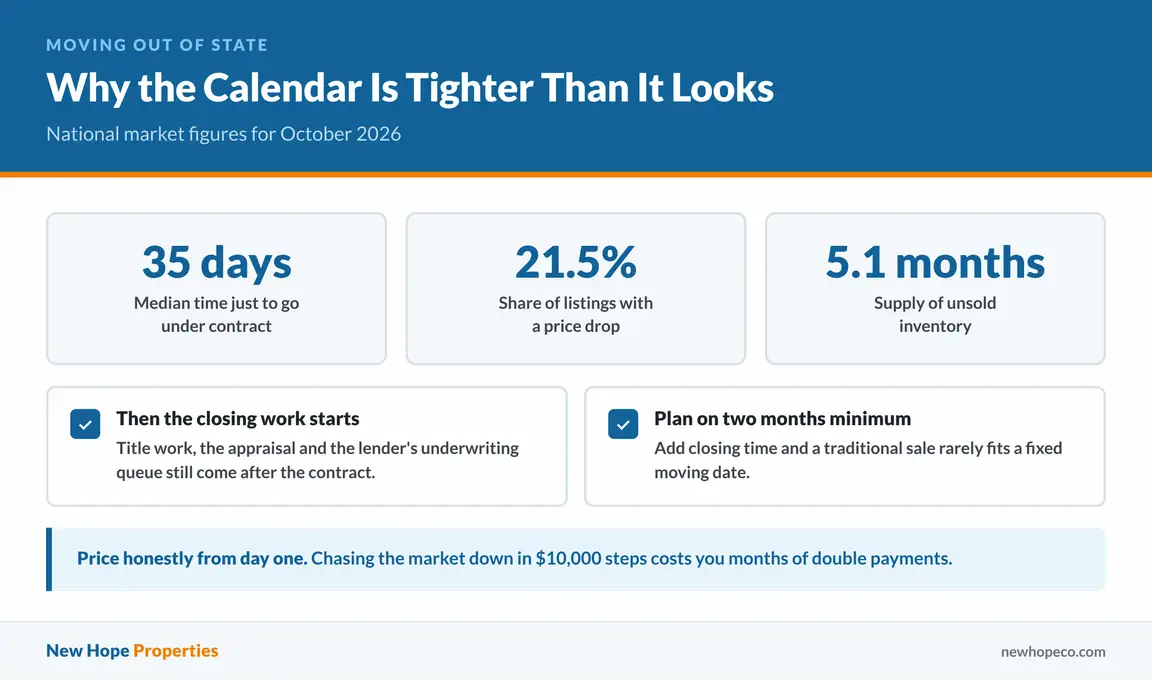

The job offer came with a start date eleven weeks out. I get that call more than almost any other, because the math on the house never fits neatly inside those eleven weeks. Homes that sold in October 2026 took a median of 35 days just to go under contract, up from 33 days in September and 34 days a year earlier. The title work, the appraisal, and the lender’s underwriting queue still come after this. Add closing time and you’re staring at two months minimum. So when you need to move out of state on a fixed calendar, the house becomes the variable that doesn’t cooperate.
I’ve bought houses from sellers in almost every version of this situation. Some had months of runway. Others had a moving truck booked and a buyer’s financing falling apart on a Thursday. What follows is the stuff I’d tell you over coffee if you were sitting in my office trying to figure out how to sell your house before you move out of state.
Why Do People Decide to Move Out of State and Sell Their Home?
The reasons rarely come one at a time. A promotion lands, a parent gets sick, a marriage ends, and the house that made sense five years ago suddenly doesn’t. Work transfers still drive the biggest share of long-distance moves I see. Retirement relocation runs a close second, especially for owners sitting on a decade of equity in a house with stairs they’ve started to dread.
Cost of living pushes a lot of these decisions too. When your property insurance premium climbs three years running and your tax bill follows right along, the same income ends up buying a different life somewhere else. I’ve watched homeowners run that comparison on a napkin and decide within a week.
Family gravity is the quiet one. Grandkids move, and eighteen months later the grandparents follow. Nobody puts that on a spreadsheet, but it ends more homeownership in this country than any corporate relocation package.
Sellers deciding when to relocate should weigh market conditions, which right now are mixed in a way that rewards realistic sellers. U.S. home prices in October 2026 slipped about 0.35% from a year earlier, landing at a median of $388,634, so Redfin’s national tracking shows a market that’s cooled off some. Price drops showed up on 21.5% of listings in the four weeks ending October 25, 2026. Buyers have room to be picky again.
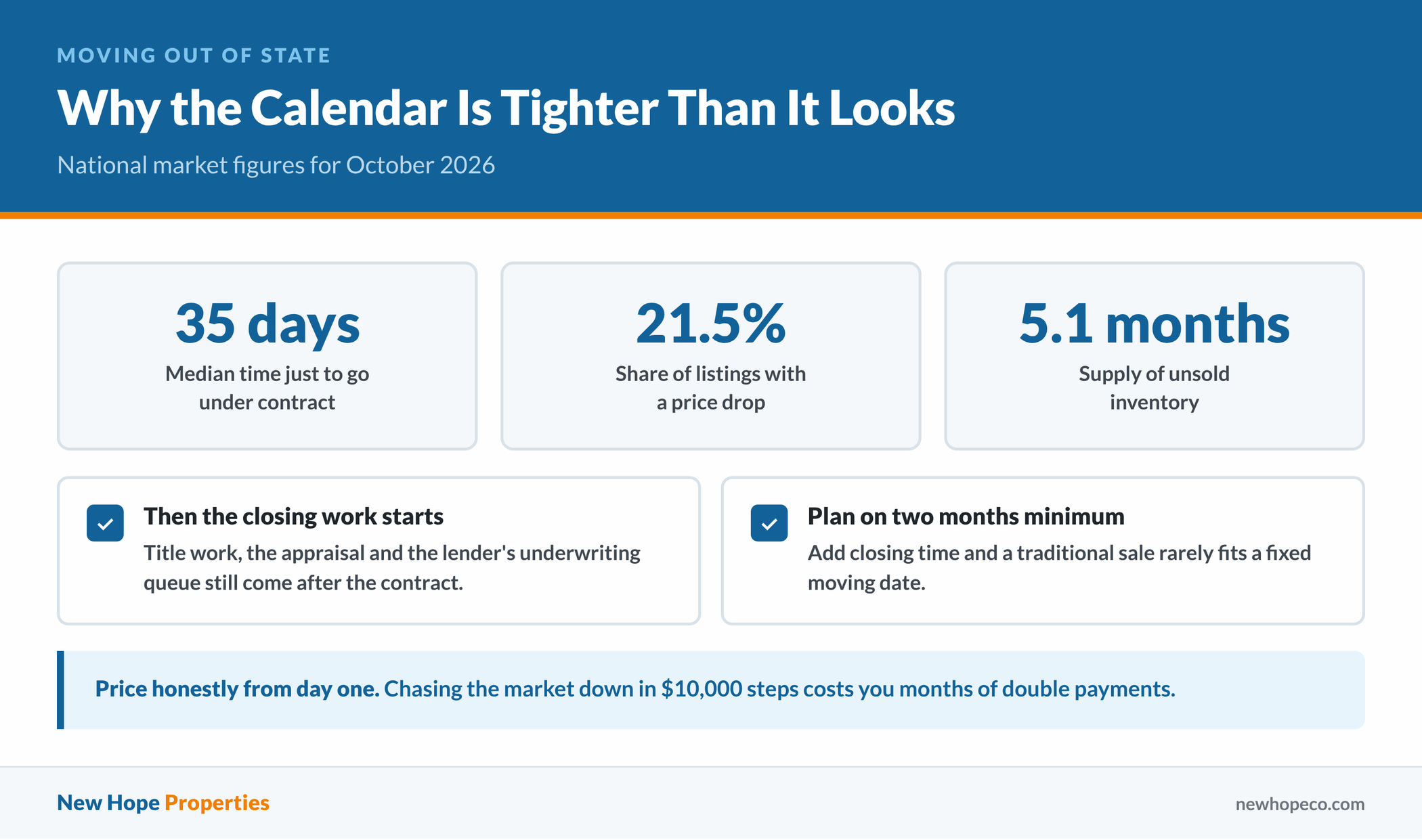
It’s not a reason to panic. Treat it as a reason to price honestly from day one instead of chasing the market down in $10,000 increments while your new mortgage payment starts in another state.
Who Needs to Sell a House Before an Out of State Move?
A teacher accepts a position 900 miles away in June and plans to list the house in July. By September she’s paying rent in her new city and a mortgage on an empty house she can’t walk through.
That’s the profile. Anyone whose new housing cost starts before the old one ends needs to take the sale seriously, early. Carrying two payments is survivable for a month and corrosive after three.
Landlords with a single rental property often end up in this group. Managing a tenant from two time zones away sounds fine until the water heater fails on a holiday weekend, and that’s usually when the regret sets in. Some owners handle it beautifully for years; most sell within eighteen months of moving and wish they’d done it sooner.
Military families face a version of this with less flexibility, since orders don’t negotiate. Heirs who inherited a house in a state they don’t live in are in the same boat. I’ve seen divorcing couples land there too, needing the equity split before either person can buy again.
Then there’s the group nobody warns: sellers whose equity is thin. If you bought recently and your loan balance sits close to today’s value, the commissions and closing costs can eat the whole cushion. Have you actually run the numbers on what you’d walk away with after everyone gets paid? Do it before you book movers, because that figure shapes every other choice you make about how to move out of state.
A few years back I worked with a family who’d watched two separate agent listings expire with zero offers over fourteen months. The husband’s job had already relocated; the wife was still there with two kids and a basement that flooded every spring. We closed in under three weeks and they stopped bleeding two housing payments.
What Should You Do to Get Your House Ready Before You Move Out of State?
Don’t repaint the whole interior. I say this to sellers constantly and they look at me like I’ve lost it. A fresh coat on every wall rarely returns what it costs, and you’re trying to leave, not renovate.
Fix what a buyer’s inspector will flag and what a lender will balk at. A roof past its life, a failing furnace, active water intrusion, a deck pulling away from the house, those kill sales. Cosmetic dings don’t, not in a market where buyers already have leverage on price.
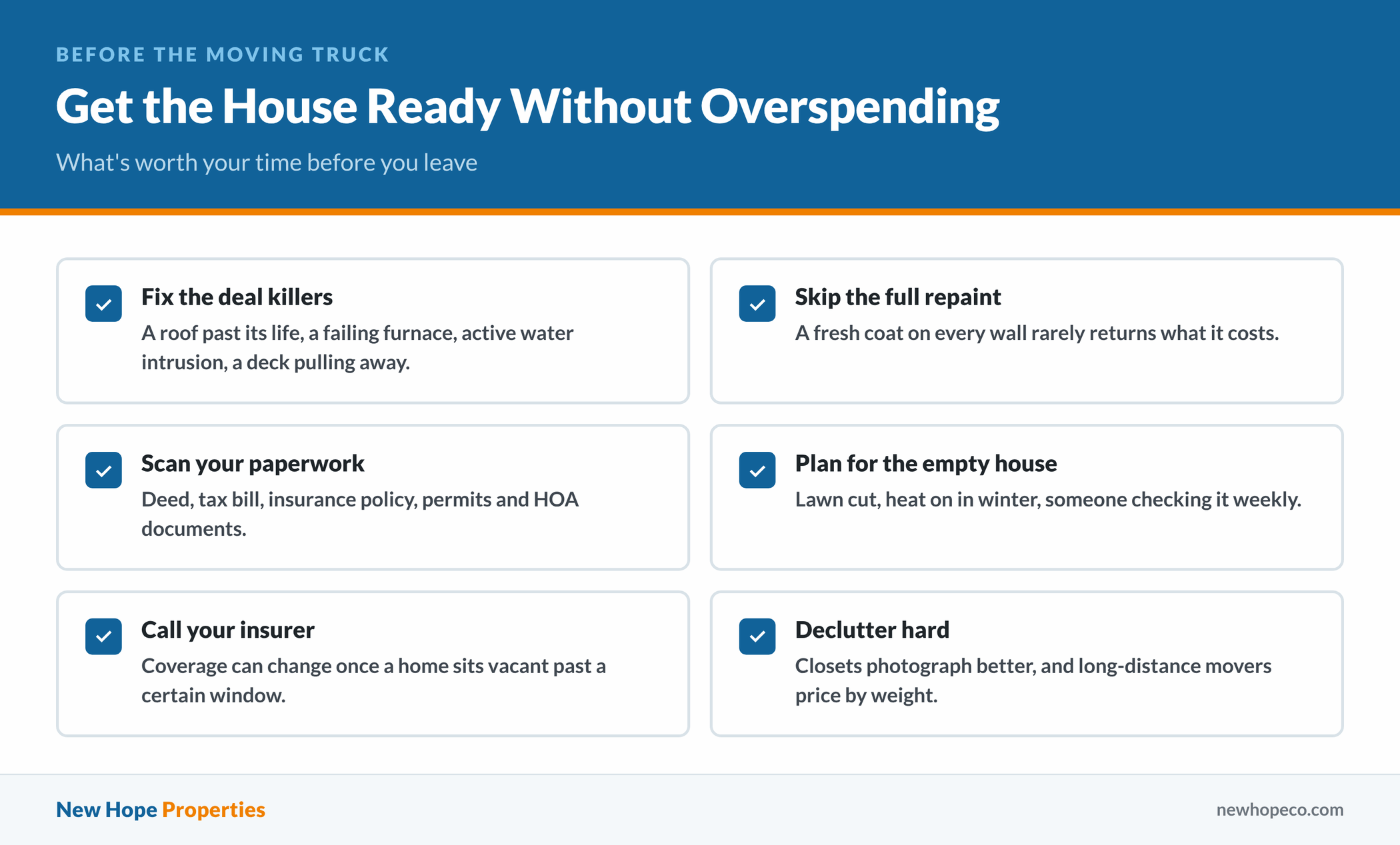
Paperwork deserves more attention than the paint. Pull your deed, your most recent property tax bill, your homeowner insurance policy, any permits for work you’ve done, and the HOA documents if you have an association. Scan all of it before the movers box up your file cabinet. Sellers who can answer a title company’s question in an hour close faster than sellers digging through storage in another state.
Think about what happens to the property after you’re gone. An empty house needs the lawn cut, the heat kept on in winter, and someone checking it weekly. Many homeowner insurance policies change coverage once a home sits vacant past a certain window, so don’t assume your current coverage rides along, call your insurer and ask directly.
Decluttering does help, and it’s the one prep task I’ll push hard. Half-empty closets photograph better than stuffed ones. If you’re hauling less across state lines, your moving company bill drops too, since most long-distance movers price by weight.
How Do You Find an Agent to Sell Your House When You Move Out of State?
Most sellers pick their real estate agent the wrong way: by who they already know.
Your cousin’s neighbor got a license last spring. A relocation sale requires more than that, since you’ll be unreachable during showings and depending on someone else’s judgment at a distance. What you want is a real estate broker or agent with genuine relocation experience, measured in closed transactions, not years holding a license.
Ask three questions in the interview. How many listings did you close in the past twelve months within two miles of my address? What’s your average days on market compared to the local MLS figure? Who physically checks the property when I’m gone?
That last one separates the serious ones. An estate agent who shrugs at vacant-home management is telling you something. Push for specifics on communication too: weekly written updates, not a text when something happens.
Commission is negotiable, and it’s always been that way. The structure matters as much as the percentage. A listing agreement that locks you in for a year with no cancellation clause is a trap when you’re a thousand miles away and unhappy. Ask for a 90-day term with an option to renew.
Know what an agent can’t fix. Market conditions in October 2026 had unsold inventory at a 5.1-month supply, up from 4.7 months in September and 4.4 months a year earlier. This is within the 4.5 to 6 month band generally considered balanced. A good agent markets well and prices right. Neither skill conjures buyers who aren’t shopping.
What Are Your Options for Selling a Property When You Move Out of State?
Pick the wrong path and you’ll spend six months paying for a house you no longer live in, then accept less than the offer you turned down in week two. I watch it happen every year.
Listing with a realtor on the open market generally produces the highest gross price. It also takes the longest and demands the most from you: showings, inspection negotiations, repair credits, and a buyer whose financing can collapse late. For sellers with time and a property in good condition, that tradeoff usually pencils out.
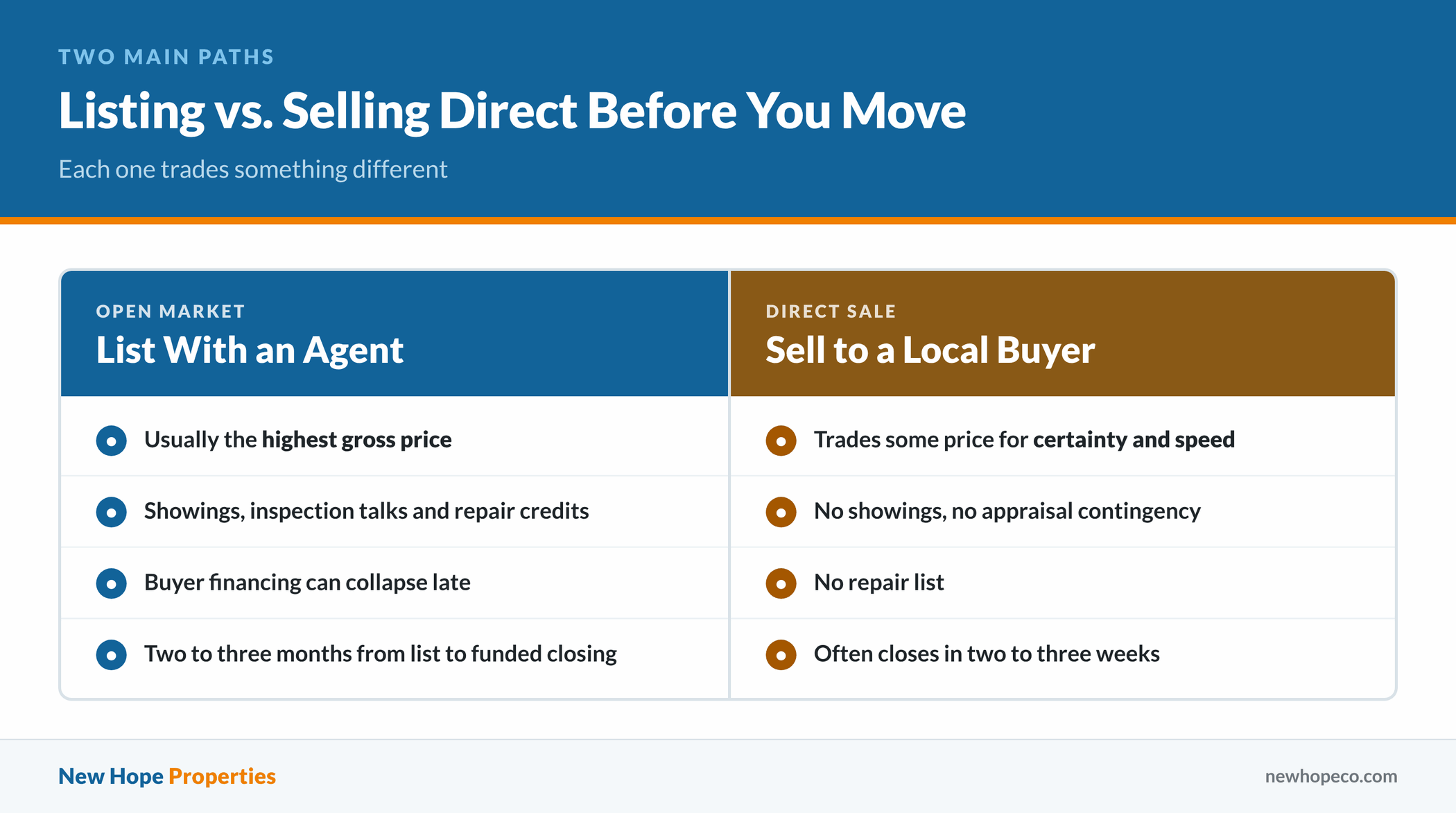
Selling direct to a local investor trades some price for certainty and speed. No showings, no appraisal contingency, no repair list, and a closing date you choose. That’s the option I’m in, so weigh my opinion accordingly, though the honest version is this: it fits sellers whose carrying costs or condition problems outweigh the spread. New Hope Properties works with homeowners in exactly this spot, and you can see how the process runs.
Renting it out is the option people choose emotionally and regret practically. If you wouldn’t buy that property as an investment today, you shouldn’t become its long-distance landlord by default.
For sale by owner saves commission and costs time. Managing buyer inquiries, scheduling access, and handling a contract from another state is a real job. Some owners pull it off. Most underestimate it.
A short sale enters the picture when you owe more than the house will bring. Your lender has to approve the sale and the payoff shortfall, so plan on the process adding months. Talk to a real estate attorney before you go that direction, since the deficiency rules differ by state and the consequences follow you.
How Do You Settle in After You Sell Your House and Move Out of State?
“When do I stop worrying about the old house?”
Not at closing, quite. Keep your closing package somewhere you can find it, since your tax preparer will want the settlement statement next spring. Forward your mail, cancel the old homeowner insurance only after the deed records, and confirm the utilities transferred out of your name on the right date.
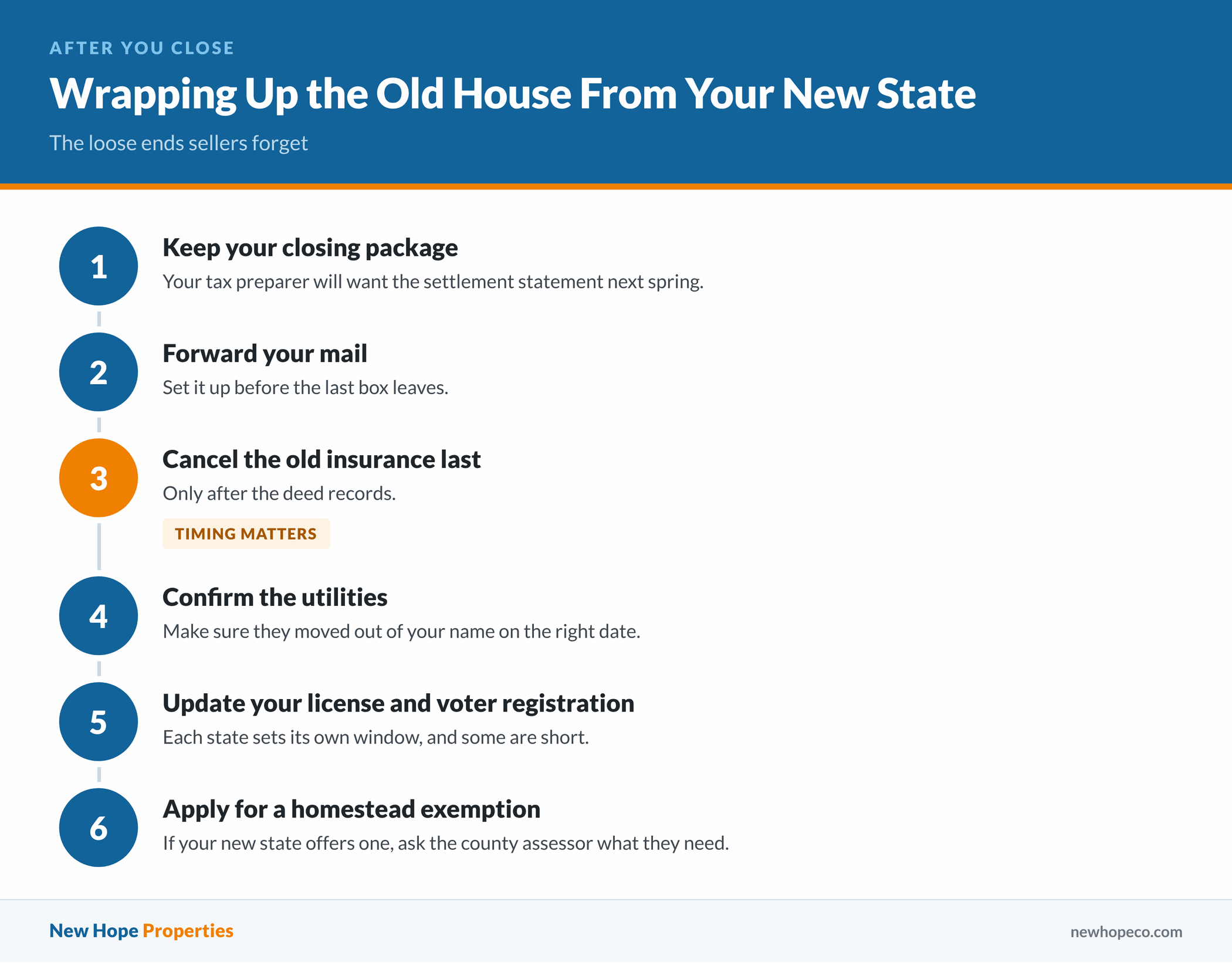
Update your driver’s license and voter registration in the new state within whatever window that state sets, since the deadlines vary and some are short. The DMV or secretary of state website in the new state gives the current requirement.
If your new state offers a homestead exemption, apply for it. States vary widely on filing deadlines, residency proof, and how much the exemption shaves off your assessed value. The property appraiser or assessor in your new county can tell you exactly what they need and when. That phone call is worth more than any article, including this one.
One more thing worth saying out loud: the grief is real. People who’ve owned a home twenty years sometimes feel genuinely low for a month after closing, even when the move was their idea and the right call. So give that feeling time instead of fighting it.
A seller reached out mid-divorce with one request: handle it. Neither spouse wanted to coordinate showings with the other, the garage still held a shared woodworking shop neither one would claim, and their attorneys needed a clean number for the settlement. We’ve seen enough of these to know the tools in the garage weren’t getting split fairly either way. So we bought it as it stood, tools and all. Both of them signed remotely from different cities.
Frequently Asked Questions
Can I Sell My House After I’ve Already Moved Out of State?
Yes, and plenty of sellers do exactly that. Remote closings have become standard practice, so you can typically sign, notarize, and fund without returning. Expect a slightly longer timeline for document shipping if your state requires wet-ink signatures, and expect your agent or buyer to coordinate property access on your behalf.
Will I Owe Capital Gains Tax If I Sell My Home and Move Out of State?
Only on gain above the federal home sale exclusion, assuming you meet the ownership and use tests. Moving away doesn’t disqualify you, since the rule looks backward at the five years before your sale, not at where you live afterward. If you fall short of the full requirement because of a job change or health issue, ask your tax preparer about the prorated version.
Should I Rent My House Out Instead of Selling Before I Move Out of State?
Run the actual numbers before you decide, including property management fees, vacancy months, and repairs you’ll authorize sight unseen. Renting works well for owners who want long-term exposure to that market and have cash reserves for surprises. When the plan is mostly about avoiding the decision, selling is usually cleaner.
How Fast Can I Close If My Move Out of State Date Is Fixed?
A traditional listing realistically needs two to three months from list date to funded closing in current conditions. With a direct sale to a local buyer, you can often close in two to three weeks, because there’s no appraisal, no lender underwriting, and no financing contingency. Your title company’s turnaround on the search is usually the real constraint.
What Documents Do I Need to Sell a House Remotely?
Nearly every transaction needs your photo identification, the deed, your mortgage payoff information, and the title company’s signing packet. Some states require witnesses in addition to a notary, and a few restrict which real estate documents qualify for remote signing, so your closing agent should confirm the format early. Keep a mobile notary’s contact information handy as a backup.
Do I Need an Attorney to Sell My House and Move Out of State?
Several states require an attorney at closing, and in others it’s optional but often worthwhile when you’re signing from a distance. An attorney reviewing your sales contract before you sign is cheap insurance against a contract term you’d regret later. Your title company can tell you which category your state falls into.
Plenty of homeowners want to weigh a listing against a direct sale with somebody who’s done this a few hundred times. For that conversation, reach out to New Hope Properties. We’ll look at your situation, give you a straight read on what your house would bring either way, and tell you plainly if listing is the better move. No pressure, no obligation, and no hard feelings if you decide to go another direction.
Your Grand Junction House and an Out of State Move
The local market gives Mesa County owners some room, but not much. Mesa County’s median sale price was $414,000 in September 2026, up 1.4% from a year earlier, according to The Bray Report. Active listings climbed at the same time, so local buyers have more homes to compare against yours.
New Hope Properties is one of the cash home buyers in Grand Junction that can set a closing date around your plan to move out of state.
We also buy from homeowners in Fruita and across Colorado who are relocating for work, family or retirement.
Talk With New Hope Properties Before You Move
Once your date to move out of state is locked in and the house hasn’t sold, you can contact our team and ask what a direct sale would look like. Fill out the form below with your address, and we’ll give you a straight answer on timing and price.
Helpful Colorado Blog Articles
- How to Sell a House By Owner in Colorado
- How to Sell a House During a Divorce in Colorado
- Can You Sell a House With a Mortgage in Colorado
- How to Sell Rental Property in Colorado
- How Much Does It Cost to Sell a House in Colorado
- Selling a House With Mold in Colorado
- Can a Jointly Owned Property Be Sold by One Owner in Colorado
- How Long Should You Live in a House Before Selling It
- Sell House With Water Damage in Colorado
- How Long Does It Take to Force the Sale of Property in Colorado?
- Can You Sell a House With a Lien in Colorado
- Can You Sell a House in Foreclosure in Colorado
- How to File a Quit Claim Deed on a House in Colorado
- How to Sell Your House Before Moving to Another State